Introducing green infrastructure in cities is not, in itself, an innovative element, but doing so through a social justice lens emerges as the key differentiating factor. Green infrastructure goes beyond the mere provision of landscaped or gardened areas; rather, like any infrastructure, it seeks to provide certain services to the population. In this case, it aims to deliver ecosystem services to the population — especially the most vulnerable — such as thermal regulation, landscape aesthetics, lower levels of pollution and shading, among others.
Urban vegetation is not only a matter of aesthetics or wellbeing: it is essential infrastructure for life in cities. It provides shade and cooling, improves air quality, reduces noise pollution, captures CO₂, regulates the water cycle, and offers spaces for social interaction and mental health. In the context of climate change and urban crisis, vegetation has become a key element of the ecological transition. However, this transition is not always being fair.
In many cities around the world, access to green spaces and urban vegetation is deeply shaped by income, social class and the history of urban planning. Where there is higher income, there is more green. Where there is greater vulnerability, there is more concrete, more heat, more noise and more pollution.
Unequal Urban Green Geography: Specific Cases of Santiago and Lima
In Santiago de Chile, remote sensing and urban cartography studies reveal a city divided in two: the more affluent north-eastern sector is covered with gardens, parks and urban tree cover, while the southern and western areas, more vulnerable and denser, have barely any natural shade. Inequality in access to green spaces is so pronounced that it is described as “ecological segregation.”
Another clear case is that of the Peruvian capital. Lima is one of the largest desert cities in the world, where greenery appears to be an almost exclusive privilege. While the cliffs of districts such as Miraflores or San Isidro are carpeted with gardens and crowned by parks, palm trees and ornamental vegetation maintained through intensive irrigation systems, the cliffs of neighbouring lower-income districts are devoid of vegetation and parks. Moreover, the large urban cones on the periphery are spread across barren hillsides, without trees, squares or functional parks. The contrast between landscaped ravines designed for tourism and neighbourhoods without a single patch of shade is a stark reflection of urban inequality.
Spain: Between Green Planning and Socio-Spatial Inertia
In the Spanish context, although differences may appear more nuanced, inequality is also present. Many middle- to upper-class residential neighbourhoods — especially those developed in recent decades — feature wide tree-lined avenues, community gardens and well-maintained urban parks. Meanwhile, many working-class districts, particularly older or more densely built ones, suffer from a structural deficit of vegetation.
However, there are exceptions that invite reflection. In Bilbao, peripheral neighbourhoods such as Otxarkoaga, Txurdinaga or Rekalde — traditionally more modest — have more vegetation and tree cover than denser and more affluent central areas such as Abando or Indautxu. This is partly explained by their history of dispersed and sloping urban development, which has allowed more green areas to be preserved on hillsides or in inter-block spaces. Even so, this vegetation is not always accessible, well maintained or conceived as infrastructure for wellbeing.
Vegetation, Health and Climate Vulnerability
Urban vegetation is a social determinant of health. Numerous studies have shown its impact in reducing cardiovascular and respiratory diseases, chronic stress, and in improving psychological wellbeing. In addition, during heatwave scenarios, neighbourhoods with less greenery experience greater thermal exposure and a lower capacity to adapt.
In this regard, an ecological transition that does not take into account the unequal distribution of green infrastructure may deepen social and climate divides. It is not enough to plant more trees; they must be planted where they are most needed, guided by criteria of territorial justice, public health and community participation.
To integrate ecological justice into urban planning, the following points should be considered:
- Prioritise the renaturalisation of vulnerable neighbourhoods and heat-island areas.
- Design green infrastructure that is functional, accessible and well maintained.
- Incorporate green equity indicators into urban plans.
- Ensure the participation of local communities in the design of spaces.
- Finance long-term strategies to conserve and regenerate urban greenery.
Vegetation cannot be an urban luxury. It must be recognised as a basic environmental right. From the perspective of the ecological transition, it is urgent to rethink green spaces as a guarantee of climate justice and collective wellbeing.
At Naider, we work to ensure that the cities of the future are not only greener, but also fairer.
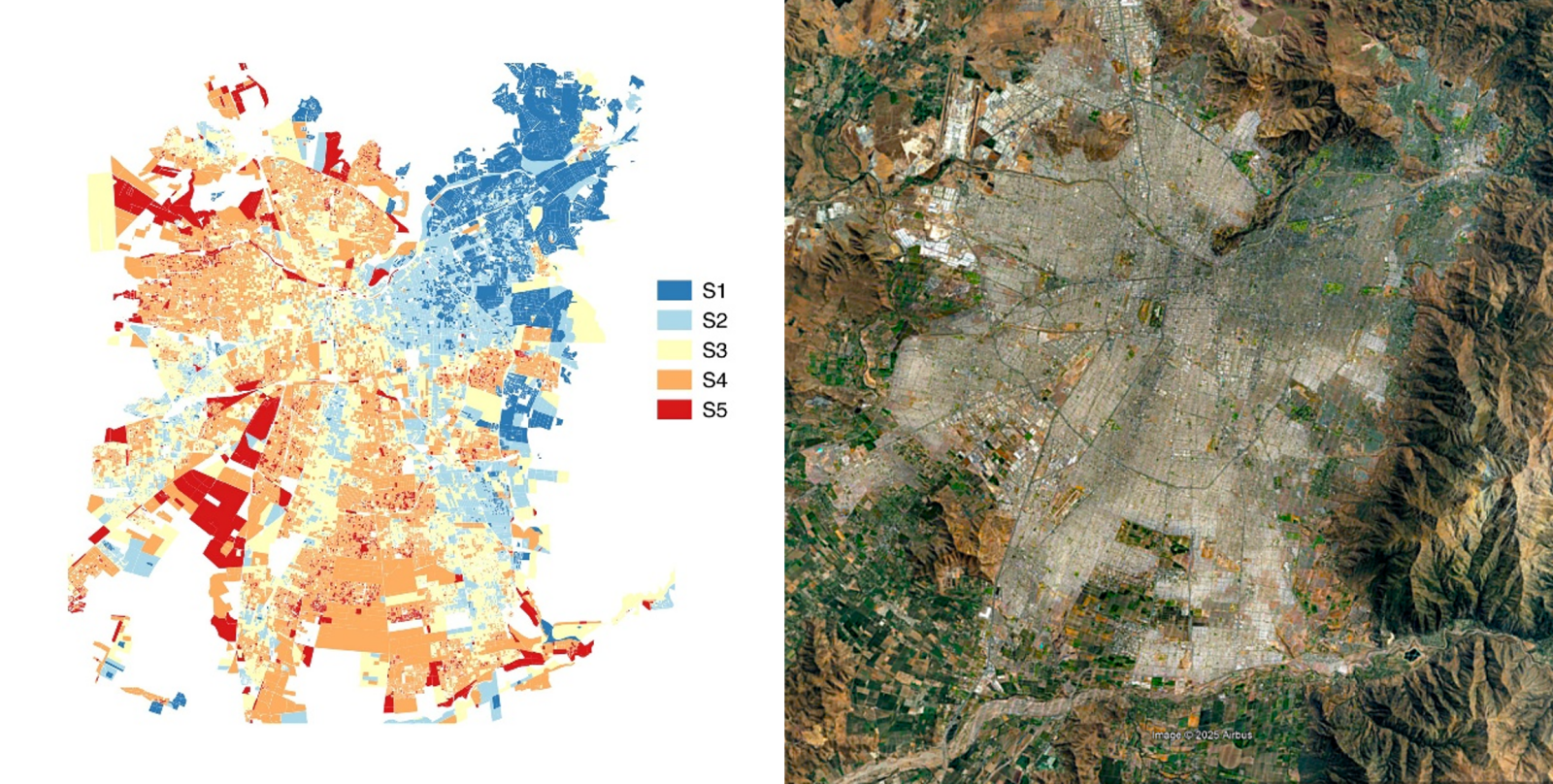
Fuente: Santiago according to socioeconomic level, where S5 is the most vulnerable. © Teodoro Dannemann, Boris Sotomayor-Gómez, and Horacio Samaniego, based in Observatorio de Ciudades UC
Main illustration: William Justen de Vasconcellos