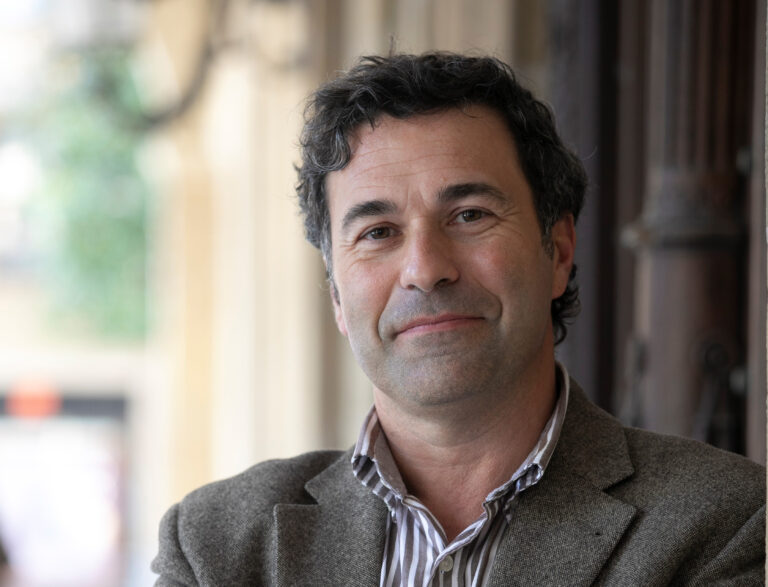
Fernando Nebreda | Director General of Oarsoaldea and President of Garapen
Fernando Nebreda Díaz de Espada (Miranda de Ebro, 1963) is the General Director of the Oarsoaldea regional development agency and President of Garapen, the association that brings together the development agencies established by local authorities in the Basque Autonomous Community. At the nationwide level, he also served as President of the Network of Entities for Local Development (REDEL) for ten years, and remains a member of its Board of Directors. He holds a Law degree, a Master’s Degree in Business Management, and a Master of Competitiveness.
« Public-private collaboration is only transformative when it materialises in projects that bring real value to the territory and force us out of our comfort zones »
Egun on Fernando, and many thanks for accepting Naider’s invitation. It’s a pleasure to speak with you, not only because of your leadership at Oarsoaldea, but also because, through Garapen and REDEL, you occupy a privileged position from which to observe what’s working, and what isn’t, in local development. If it’s agreeable, let’s begin with what’s closest to us. In Oarsoaldea, you’re leading the process of reflection to define the district’s transformation and competitiveness strategy over the next ten years. Would you care to reveal any significant aspects that have emerged in that process?
I’d rather not pre-empt the results of the participatory process we’ve initiated with the political, economic and social agents of the territory. It will surely yield new approaches and proposals.
But I can share elements that are already having a structural impact on the Agency’s work. I would emphasise the growing significance of demographic challenges for both economic and social activity. Things like attracting workers from diverse profiles, both highly qualified and more basic, in a context of endogenous demographic decline; the radical shift occurring in new generations’ attitudes towards work; and the succession of businesses: these topics will surely command our agenda in the coming years.
Another fundamental pillar is the transition to a sustainable productive model, reflected in challenges such as the circular economy, the progressive adoption of renewable energy sources, and corporate social responsibility.
Innovation, both technological and non-technological, will be the basic axis upon which the long-term viability of the economic fabric rests, with digitisation playing a starring role.
From a more socially-oriented development perspective, I would highlight the progressive transformation that has taken place in recent years in the profile of the job-seeker, increasingly closer to a situation of social exclusion and with a significant proportion of immigrant population, which has emerged as a growingly important collective that could represent a great opportunity in a context of scarcity of available workers.
Added to this is the difficulty in accessing housing, which will likely require us to play an active role as a tool for municipalities in this realm.
In terms of territorial development, I would highlight two challenges: improving the district’s qualitative position regarding the treatment it receives as host to a general-interest infrastructure such as the Port of Pasaia; and integrating more effectively into the cross-border space defined as the Basque Eurocity San Sebastian-Bayonne, to take advantage of the enormous economic, social and cultural opportunities it presents.
The demographic challenge is becoming more and more relevant: attracting workers, business succession, and changes in new generations’ relationship with work will shape our agenda in the coming years.
Given your deep knowledge of the economic, social and institutional fabric of the regions, would you say we are entering a new cycle for development agencies? Are they managing to redefine their role in an increasingly complex world?
It is clear that the role of development agencies has evolved greatly since their origins, which in the Basque Country goes back more than 30 years. At the outset, agencies were essentially service providers, mainly linked to employment and entrepreneurship.
Later, agencies became spaces for building strategic consensus at the local scale.
Today, their essential role is to facilitate local development processes, intelligently and efficiently connecting the actors involved. This new role demands developing capacities to identify key stakeholders, relate them appropriately, detect collective challenges in terms of problems as well as opportunities, and ultimately formulate projects that bring value to the territory and its agents.
Sometimes it seems as though development agencies are constantly having to justify their usefulness. Yet those nearby know the value they provide, especially when they act as a hinge between the local world and global challenges. How do you experience this in the Basque context? Do you notice any evolution in institutional or political recognition?
Local development agencies in the Basque Country, as in the rest of the State, are based on voluntarism and consensus, not on legal or regulatory grounds. That is to say, they are created through agreements adopted by municipalities that view them as suitable tools to promote the socio-economic development of their territories. But they lack a legal-administrative framework granting them specific competences. Moreover, the tasks they carry out are innovative, different from the traditional remit of municipal work. For all these reasons, from the moment they were founded, agencies have been obliged to demonstrate their effectiveness to justify their very existence, while constantly demanding from higher institutions access to the areas of action required by their municipalities (employment, economic promotion, entrepreneurship, tourism…), which is not always forthcoming.
In recent years, however, qualitatively significant advances have been made that are providing greater stability to the work of local development agencies. Among them I would highlight: the new model of collaborative governance promoted by the Provincial Council of Gipuzkoa, materialised in the framework agreement of collaboration between the Council and development agencies for the territorial development of Gipuzkoa; the “Bizkaia Orekan Sakonduz” programme of the Provincial Council of Bizkaia; the Inter-institutional Entrepreneurship Plan promoted by the Basque Government’s Department of Competitiveness; and, more recently, the new Employment Law. All of these explicitly recognise the role of local development and of the agencies themselves as key municipal tools for engaging municipalities in the levers of territorial development, showing the suitability of public-private and multilevel collaborative governance to address global challenges.
Today the essential role of development agencies is to facilitate local processes, connecting actors intelligently and efficiently.
And when we talk about public-private collaboration, something that is always on everyone’s lips but does not always materialise… What do you think are the really decisive elements for that collaboration to be genuine and transformative at the local and regional level?
The participation of stakeholders is essential. We always tend to talk about it, but the hard part is making it real and effective.
It is key to facilitate their participation in defining strategies, seeking to integrate their challenges with those of the territory. It also helps greatly to articulate their collaboration around concrete projects that bring value to them as well as to the territory, with a multi-actor and public-private perspective, as it is vital to draw each one out of their comfort zone and confront/enrich themselves with other visions beyond their own logic.
I would also add the importance of systematising participation through multiple channels, not only in-person, making use as well of the opportunities offered by new information and communication technologies.
One of the most pressing challenges is how to ensure that the ecological and digital transitions do not remain confined to the capitals or large companies. How are regional agencies responding to this dual transition? Are they finding their place in that transformation?
It is clear that in these two transitions, and in the demographic one, one of the most important challenges is to avoid the risk of economic, social and/or territorial duality. In short, ensuring no one is left behind because of unequal capacity to face these processes.
This is precisely where the role of agencies is especially relevant, since our capillarity and proximity to local actors and people allow us to design strategies and tools adapted to their real needs and capacities, bringing them approaches and opportunities which, otherwise, would be almost impossible to address due to limitations in time, human resources, materials, etc.
Moreover, our role as facilitators of these processes also allows them to establish collaborations with other actors they would otherwise never have known. As can be seen, it is not a matter of whether agencies find their place or not, but rather that this work is part of the very DNA of 21st-century development agencies.
A good example is the “Digital SME” programme, driven by the Provincial Council of Gipuzkoa in collaboration with development agencies, which in recent years has enabled hundreds of SMEs in the territory to embark on digitalisation processes.
Agencies have always had to prove their usefulness, but institutional recognition of our role in collaborative governance is increasingly evident.
And looking a bit further ahead… where do you think local development is heading? What trends do you see coming and how should agencies position themselves to remain relevant in five or ten years’ time?
I believe that, in general, we must maintain our role as meeting spaces for building consensus aimed at the socio-economic development of our territories, as well as facilitating local development processes that connect stakeholders to identify and launch projects that provide value to the territory and to themselves.
What I think will change is the way this is put into practice. In this sense, innovation must be the guiding principle of our activity, seeking new solutions to the new challenges we face. Promoting experimental spaces that encourage interaction among a wide range of public and private, business and knowledge, social and financial actors, and defining ad hoc responses for specific people, agents or situations, will gain ground over the mere provision of standardised services.
Another key for me will be smart specialisation: focusing on what the territory does best, where it has the strongest resources, actors and dynamics, instead of “trying to do everything”.
And lastly, it will also be critical to have an information management system that, beyond control and monitoring, provides knowledge we can transform into territorial intelligence, becoming the essential element for decision-making.
Mila esker, Fernando, for responding so kindly to our questions.