


what it is
A TERRITORIAL INTELLIGENCE TOOL FOR URBAN DECARBONISATION
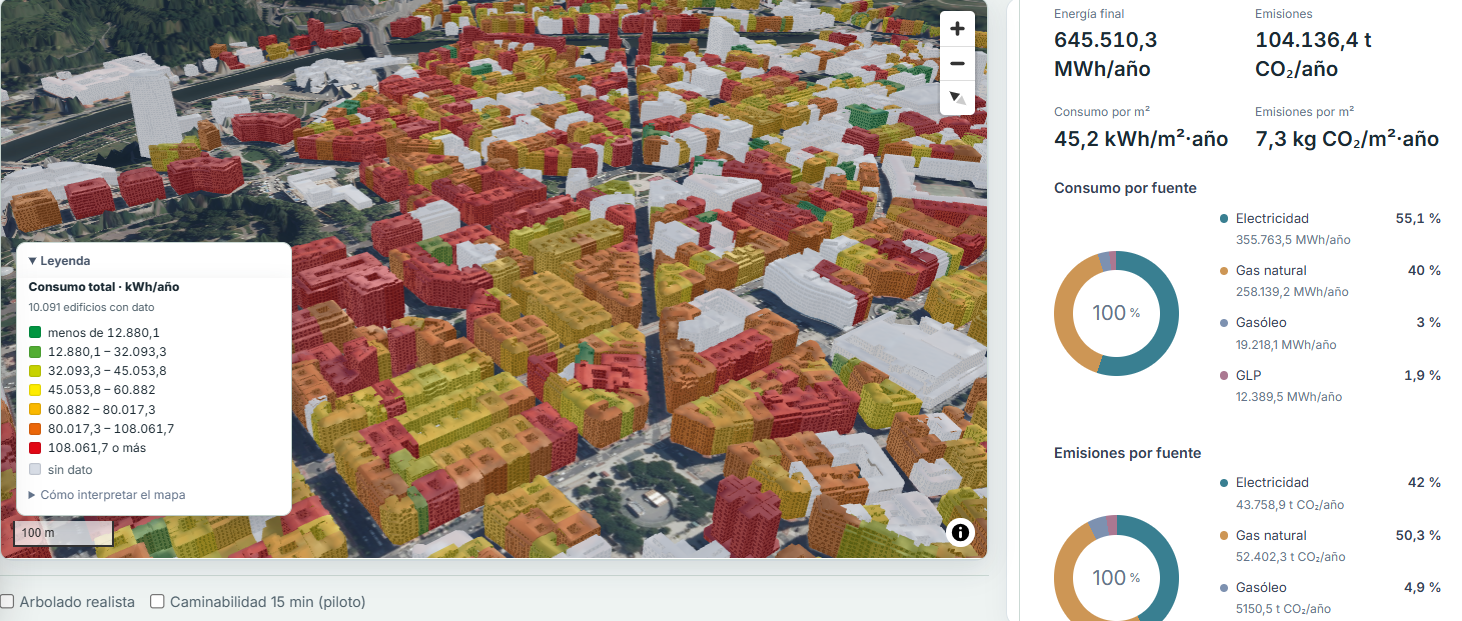
Energy and Emissions links the city’s energy balance with the analysis of its neighbourhoods and buildings. It brings together energy use, emissions and the characteristics of the building stock to identify priorities for action and compare the energy, environmental and economic impact of different measures.
objectives
LESS ENERGY AND EMISSIONS. MORE CAPACITY TO DECIDE
Energy balances show how a municipality is evolving, but investment needs a more specific reading: which sectors concentrate demand, where the needs are located and which combination of measures can deliver most. The tool connects municipal targets with action on the ground to prioritise retrofitting, assess alternatives and track decarbonisation.
features
MONITORING, SCENARIOS AND BUILDING-LEVEL ANALYSIS
- Energy monitoring: trends in energy use and emissions by sector and energy source, year-on-year comparison and progress towards targets.
- Intervention scenarios: simulation of retrofitting, heating and cooling, lighting, equipment, renewable energy and mobility measures, with their estimated effect on energy use, emissions and investment.
- Buildings, housing and social context: maps of energy, emissions and energy ratings by building, linked to data on housing, population and economic activity.
beneficiaries
CITY COUNCILS, AGENCIES AND SUPRA-MUNICIPAL BODIES
Energy, environment, housing and planning departments, development agencies and bodies coordinating the energy transition of several municipalities. Each implementation starts by checking which data exist and at what scale they can be interpreted.
applications
USES IN CITY MANAGEMENT
1. Preparing a retrofit programme: selecting the areas where initial efforts should be focused and comparing the reach of different measures.
2. Updating the decarbonisation roadmap: reviewing historical series, setting a baseline and exploring combinations of measures for buildings, mobility and services.
3. Coordinating departments and communicating decisions: sharing a common reading across energy, housing, environment and planning to prepare meetings, reports and communication of results.
demo
PRODUCT DEMONSTRATION
The video shows the simulation of energy intervention scenarios in a real urban setting.
The images and video show the Bilbao 2050 case, promoted by Bilbao City Council with technological collaboration from PwC, NAIDER and TEKNEI. Scenarios are model estimates.