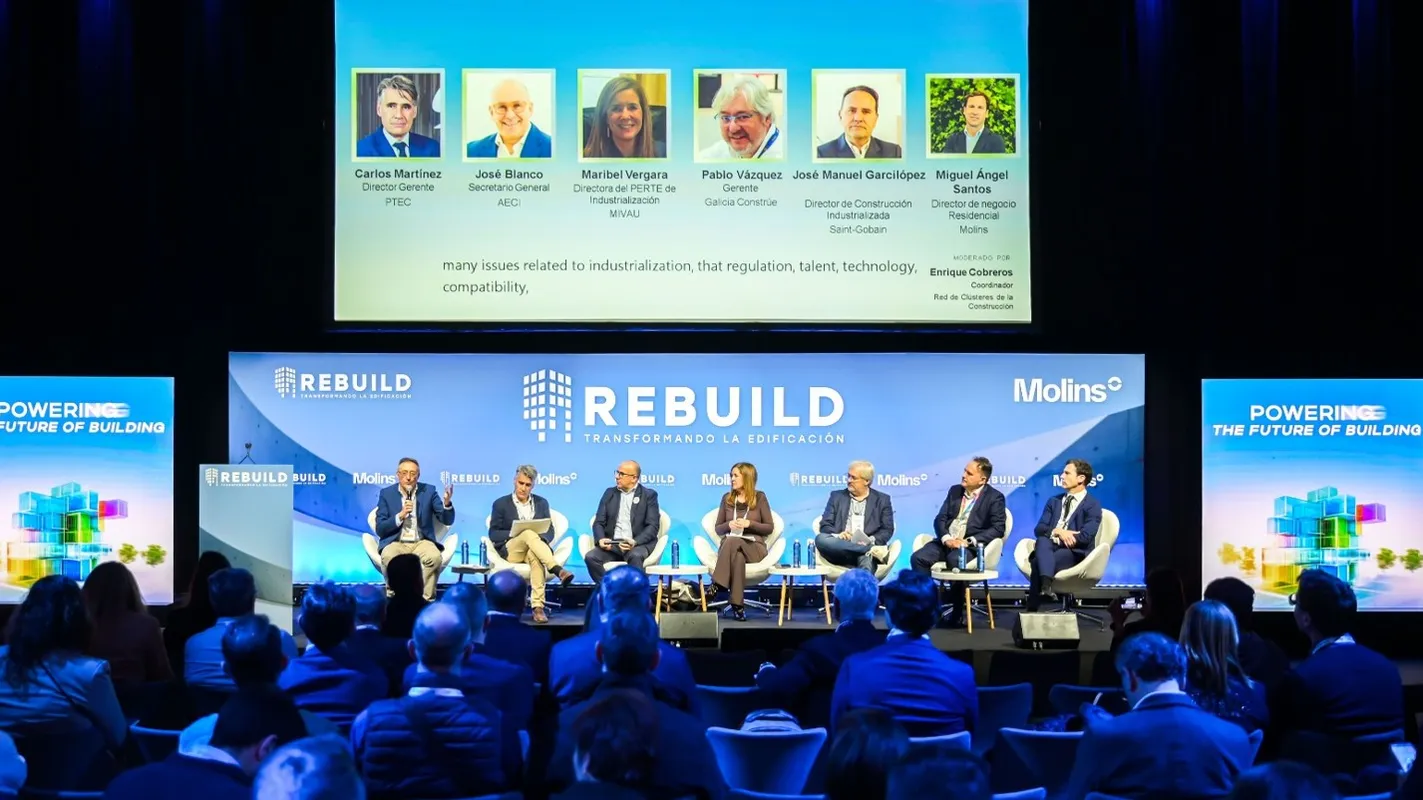
NAIDER attended the first day of REBUILD 2026, Spain’s leading event on industrialised construction, held at IFEMA Madrid. The event brought together more than 30,000 professionals and 758 exhibiting companies, offering a unique opportunity to gauge the pulse of a sector in transformation and to explore its implications for territorial development, ecological transition, and industrial competitiveness.
The day opened at the Industrialisation Forum of the Construction Clusters Network, where industrialised housing was discussed as one of the main responses to the housing deficit. The debate highlighted the need to develop certification and financing models suited to factory-based production, noting that the absence of validated frameworks for partial payment still limits scalability.
The event also saw the presentation of Proyecto Valdesc, funded through FEDER grants until 2027, which focuses on researching new circular processes and products derived from complex construction and demolition waste. This initiative connects with the growing role of the circular economy in the sector and its application to industrial settings.
Another key theme was the update of the Technical Building Code and the rollout of the National Building Renovation Plan, both presented as key drivers of transformation. Beyond energy efficiency, the debate expanded to encompass dimensions such as health, social cohesion, and decarbonisation, broadening the traditional scope of construction.
A session on Madrid’s sectoral transformation underlined the importance of aligning the entire value chain around shared projects — making clear that industrialisation is not solely a technological challenge, but also an organisational and governance one.
In parallel, innovative approaches were presented, including the Beyond the Box model, developed by architect and neuropsychologist Ana Mombiedro. The model proposes designing and assessing educational spaces based on how the brain learns and develops — reinforcing the link between the built environment, wellbeing, and public health.
The Region of Murcia, recognised as Guest Innovation Region 2026, stood out for its comprehensive commitment to industrialised construction, BIM methodology, the circular economy, and an ambitious affordable housing plan. Its approach exemplifies how collaboration between businesses, technology centres, and public administrations can drive sectoral transformation.
REBUILD 2026 confirms that the evolution of construction extends well beyond the sector itself and is consolidating as a strategic vector for territorial development. Industrialisation, new materials, circularity, digitalisation, and wellbeing are emerging as key elements that must be integrated into public strategies for competitiveness and ecological transition. In this context, NAIDER continues working alongside public administrations, businesses, and territorial stakeholders to advance this approach in the Basque Country.