Public administrations have made notable progress in recent years in the design of specific mitigation and adaptation strategies to address climate change. Energy efficiency in buildings, the deployment of renewable energies, green infrastructure, nature-based solutions and ecological urban planning have become established as fundamental pillars for reducing emissions and strengthening territorial resilience. However, experience shows that, on their own, these sector-specific instruments are not sufficient to trigger the structural changes required by the ecological transition. Their scope, although deep and necessary, is limited to the areas directly involved in their design and implementation.
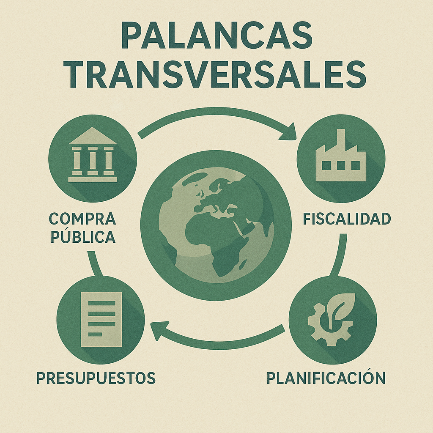
By contrast, there is a set of cross-cutting climate action instruments —green public procurement, climate taxation, climate-aware budgeting, and climate-aware planning and regulation— whose transformative potential remains undervalued. Their direct effect may appear limited when compared with major mitigation or adaptation actions, but their capacity for multiplication, scalability and cultural change makes them essential tools for accelerating the ecological transition from within public administration and across society as a whole.
Although these cross-cutting instruments do not replace direct interventions —on the contrary, they complement them and make them more effective— their capacity for permeation is considerable. They reach areas of public administration that are not traditionally regarded as part of the ecological transition; they involve professional profiles far removed from the environmental field; they influence everyday, operational decisions which, when accumulated, have a substantial impact; and they generate new ways of operating that ultimately normalise sustainability as a basic criterion of public management. By virtue of their cross-cutting nature, these instruments reach more people, sectors and administrative processes than any purely sectoral strategy and can therefore exert a driving effect across the territory as a whole.
Moreover, they possess a transformative power that goes beyond public administration. By changing the rules of the game, they shape private-sector behaviour, reorient consumption habits and contribute to the construction of a new social imaginary around what it means to act responsibly in the face of the climate crisis. In essence, they are drivers of cultural change, capable of embedding the climate perspective in the deep structures of institutions and of economic and social life.
Green public procurement is a paradigmatic example. Although its immediate impact on emissions or adaptation may be moderate, it introduces environmental criteria into all procurement processes, from basic supplies to complex infrastructure. This compels suppliers and companies to transform in order to compete, generating a pull effect in the market that is far broader than that of any specific sectoral action. Each procurement process thus becomes a mechanism for cultural and economic change, capable of steering private supply towards more sustainable models. The same applies to climate taxation, which makes it possible to internalise environmental costs and reorient consumption and production decisions. Beyond their revenue-raising function, these fiscal instruments send clear signals about administrative priorities and about the types of behaviour that should be incentivised or discouraged. And when applied at scale, they impact sectors and actors that would never be reached by specific energy or urban policies.
Climate-aware budgeting, in turn, introduces the environmental variable into the very core of decision-making. It allows every euro of public spending to be examined through a climate lens, revealing inconsistencies, guiding priorities and making the true scope of public policies visible. It is an instrument of structural alignment: it not only enables the financing of climate-related actions, but also prevents other investments from perpetuating models that are no longer sustainable.
Finally, cross-cutting climate-aware planning and regulation acts as the institutional architecture that makes all of the above possible. If urban, sectoral or strategic plans do not explicitly incorporate climate criteria, public administration will continue to reproduce decisions that fail to respond to current risks and needs. Integrating the climate perspective into regulation allows every project, every permit and every public or private action to be governed by a single coherent and forward-looking framework aligned with climate science.
However, these instruments are not without challenges. If they are implemented without a clear methodology, without adequate training, without validated criteria and without a deep reflection on their real impacts, they can become mere exercises in greenwashing. They may reproduce the same practices as always, but cloaked in environmental language that transforms nothing. For this reason, their success depends on a rigorous process of capacity-building, technical design and continuous evaluation, which avoids loose interpretations and ensures that they act as genuine levers of transformation.
The ecological transition cannot be understood solely as a set of technical measures, however ambitious and necessary they may be. It requires the integration of these cross-cutting instruments, which, acting as a structuring axis of public administration, amplify efforts, multiply impacts and make it possible to move towards a model of governance that is truly coherent with the challenges of our time. Climate transformation will be comprehensive or it will not take place at all, and these instruments are the key to ensuring that all the components of the public system —and, by extension, of the social system— move forward in the same direction.
Illustration: Clayton Kotz