Heatwaves are no longer exceptional events. They are a recurring reality that returns every summer with increasing intensity, putting the lives of thousands of people in our cities at risk. In this context, ensuring that every citizen has access to a thermal refuge within a few minutes of their home is no longer an option; it has become a responsibility of urban policy. Climate shelters are the most immediate response to this responsibility, but their true potential only unfolds when they are planned as a network, based on criteria of equity, quality and connectivity.
What is a climate shelter?
A climate shelter is a public or private space, indoors or outdoors, designed to provide safe thermal relief for citizens during episodes of extreme temperatures. It is the most immediate response to the obligation to protect public health from heat, cold and other growing climate-related risks. However, it should not be understood as an isolated facility or as a one-off solution. Its real value emerges when it forms part of a planned network, structured according to criteria of territorial equity, consistent quality standards and urban connectivity. Only then does it become a genuine resilience infrastructure.
A climate shelter is, above all, a collective guarantee: the certainty that any person, regardless of income, age or physical condition, has access to a nearby and accessible space where they can protect themselves. Extreme heat does not affect everyone in the same way. It has a stronger impact on denser neighbourhoods, with less vegetation and poorer building conditions, which often coincide with higher levels of social vulnerability.
For this reason, planning climate shelters requires analysing the city as a whole: combining social vulnerability data with maps of thermal exposure and ensuring that no neighbourhood is left outside the system. And the network does not end at the shelter’s entrance: the routes used to reach it are also part of the system. Without shaded and accessible paths, the effectiveness of the shelter is drastically reduced. The network must be designed to correct inequalities, not to reproduce them.
Requirements for real protection
Defining a climate shelter goes far beyond enabling a space with air conditioning. For a shelter to provide real protection, it must meet a set of technical and quality criteria that guarantee its effectiveness when it is most needed:
- Accessibility and free access: open and free entry, with universal design adapted to people with reduced mobility and vulnerable groups.
- Thermal comfort standards: indoor temperatures below 26–27 °C. In outdoor spaces, a high density of shade, vegetation and natural ventilation.
- Proximity: a maximum distance of 10 minutes on foot from homes, ensuring homogeneous territorial coverage.
- Basic services: free drinking water fountains, comfortable resting areas and toilets.
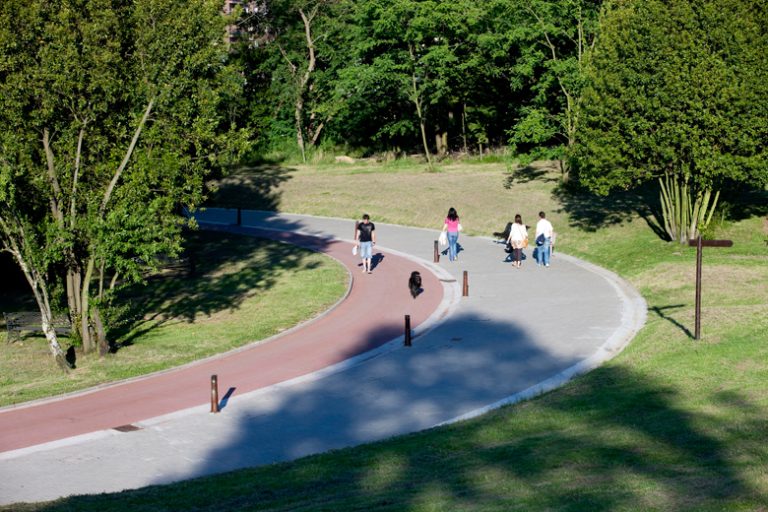
- Urban connectivity: climate-adapted access routes, with tree cover, shading structures and appropriate paving. A shelter loses effectiveness if the route to reach it crosses streets exposed to high levels of radiation.
Indoor and outdoor shelters do not compete with each other: they complement one another. Each typology covers different needs and responds better to certain situations, which is why a robust climate shelter network requires both. The following table summarises their main characteristics:
| INDOOR CLIMATE SHELTERS | OUTDOOR CLIMATE SHELTERS |
| Examples: Libraries, civic centres, museums, covered markets, shopping centres, churches, health centres, indoor sports facilities. | Examples: Urban parks, gardens, tree-lined squares, adapted school playgrounds, promenades, riverside areas with vegetation. |
| Advantages: Guaranteed climate control, protection from rain, access to toilets and services. | Advantages: Continuous availability (24h), natural ventilation, greater hosting capacity. |
| Limitations: Restricted opening hours, limited capacity, energy dependence. | Limitations: Higher maintenance requirements, effectiveness dependent on the quality of tree cover and design. |
Cities Leading the Change
Several cities have already shown that building a network of climate shelters is possible, regardless of the size of the municipality. Their experiences offer valuable lessons for any territory seeking to move in this direction.
| BARCELONA European benchmark · +300 spaces · 95% coverage within <10 minutes |
| Barcelona is now one of the leading European references in urban climate planning. Its network includes more than 300 spaces distributed across the city, allowing 95% of residents to access a climate shelter within a ten-minute walk. The success of the Barcelona model lies in the diversity of its offer: it combines indoor public facilities with continuous opening hours and regulated temperature, parks and gardens activated during the summer season, and innovative projects such as COOLSCHOOLS, which transform school playgrounds into shelters open to the public through nature-based solutions. Key innovation: integration of nature-based solutions in school facilities opened to the community. |
| BILBAO Public–private collaboration · 131 spaces · 65 indoor and 66 outdoor |
| Bilbao has developed a network of 131 spaces, with a clear commitment to public–private collaboration. The city has managed to incorporate privately owned spaces — shopping centres, churches and sports facilities — through cooperation agreements that significantly expand territorial coverage without requiring a proportional increase in public investment. This hybrid approach is particularly relevant in urban contexts where land and municipal facilities are limited, demonstrating that climate resilience can be built through partnerships with private actors committed to collective wellbeing. Key innovation: a mixed governance model that expands the network without proportionally increasing public expenditure. |
| IRUN Intermediate-sized city · 30 spaces · a replicable model for medium-sized municipalities |
| Irun demonstrates that efficient planning of climate shelters is not exclusive to large metropolitan areas. With 30 spaces identified with the technical support of Ihobe, this Basque municipality prioritised from the outset the analysis of social vulnerability, focusing particularly on children and older people in order to locate shelters where they are most needed. In addition, it has implemented a unified signage system that makes it easier for citizens to identify and make use of these spaces, turning communication into another tool within the climate strategy. Key innovation: social vulnerability analysis as the main location criterion, combined with integrated public signage. |
The future of urban adaptation
The creation of climate shelter networks represents a paradigm shift in local public policy. It is not a seasonal mitigation measure or an inventory of buildings with air conditioning; it is a strategic infrastructure that strengthens urban resilience and social justice.
At Naider, we understand that the future of urban adaptation lies in working across the territory: defining quality standards, assessing equity gaps between neighbourhoods and designing connected systems. Streets, green infrastructure and public facilities must converge in an urban design that places health and thermal protection at the centre of the city’s structural decisions. Only in this way will our cities remain habitable, supportive and truly at the service of people.
Illustration: Samuel Bourke